
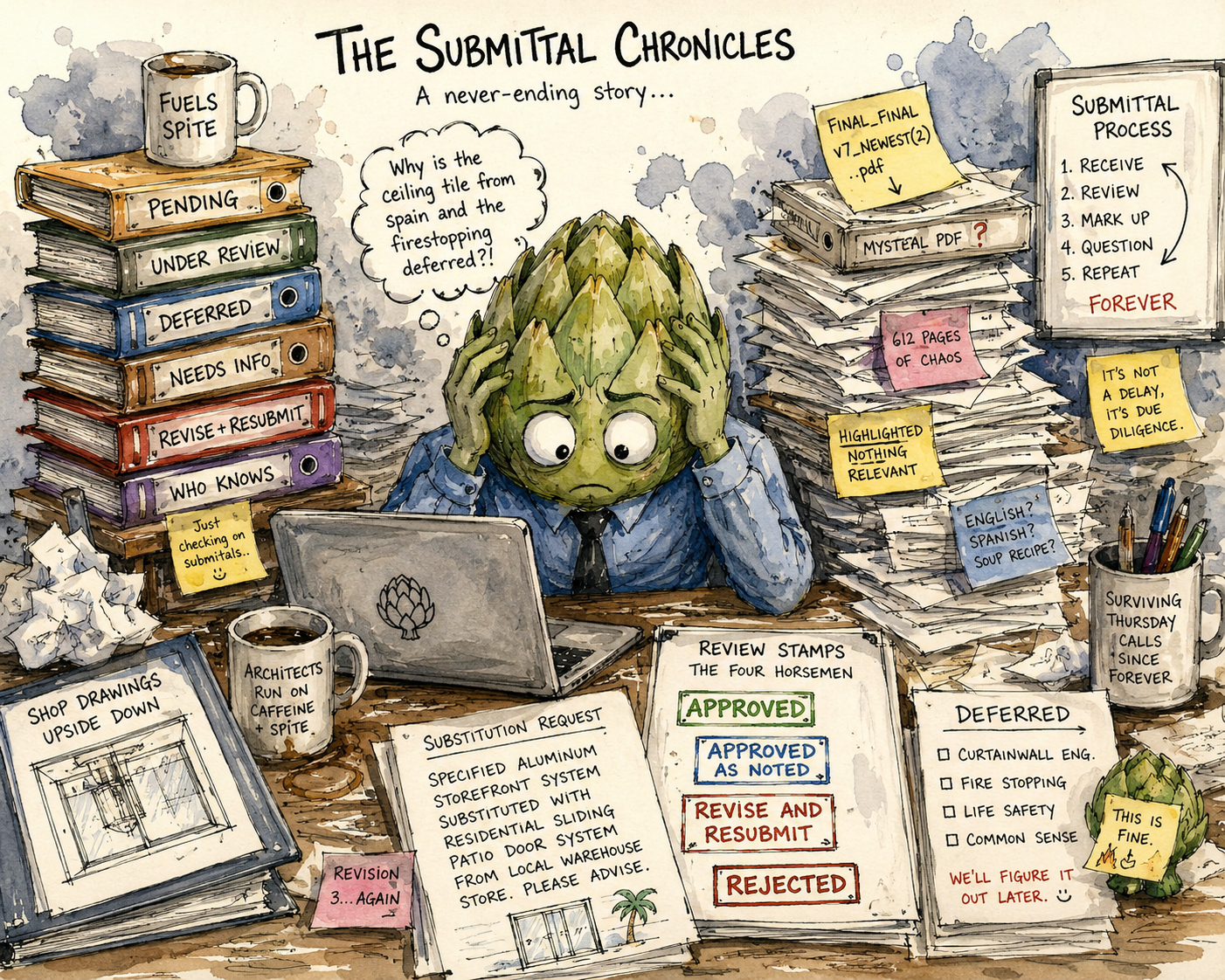
There are few things in construction more mysterious than the submittal process.
Black holes? Understandable.
Quantum physics? Makes sense.
Why a plumbing fixture submittal takes 47 days to return with the comment “Revise and Resubmit”?
Impossible to explain.
For those unfamiliar with this sacred ritual, a submittal is theoretically a simple process where a contractor submits product information to the architect for review so they can confirm the thing being installed is, in fact, the thing specified.
Simple.
Except it never is.
The process usually begins innocently enough.
A subcontractor emails the GC a PDF named:
FINAL_SUBMITTAL_v2_REAL_FINAL_USETHISONE.pdf
The GC then forwards it to the architect with the timeless phrase:
“Please review.”
No context. No urgency. No warning that buried somewhere within the 612-page PDF is a ceiling tile substitution from another continent that has not been manufactured since 1998.
The architect opens the submittal package with cautious optimism and immediately discovers:
- Product data for three unrelated projects
- Shop drawings upside down
- A handwritten dimension that simply says “close enough”
- Highlighted specifications that somehow highlight nothing relevant
- And a mysterious page in Spanish that appears to be either installation instructions or a recipe for soup
The architect sighs deeply.
This is now personal.
The submittal enters the review queue, a mythical place somewhere between “actively reviewing” and “lost forever.” Time behaves differently here. Days become weeks. Weeks become RFIs. Entire seasons pass.
Meanwhile, the contractor calls every Thursday.
“Just checking on submittals.”
The architect, currently reviewing structural steel calculations while eating cold coffee and surviving entirely on spite, calmly replies:
“We’re reviewing.”
This phrase can mean many things:
- It’s almost done
- It hasn’t been opened
- Someone is on vacation
- Or the architect is trying to determine why the submitted roofing system appears to be designed for underwater use
Then comes the review stamp.
Ah yes. The sacred stamps.
- NO EXCEPTIONS TAKEN
Rarely seen in the wild. - APPROVED AS NOTED
The industry equivalent of “I’m not mad, just disappointed.” - REVISE AND RESUBMIT
Construction’s version of “Try again, but with effort this time.” - REJECTED
Usually accompanied by silence, confusion, and one very uncomfortable coordination meeting.
Of course, no submittal journey is complete without substitutions.
Every project eventually receives that one magical request where a contractor proposes replacing the specified product with something “equal.”
It is never equal.
“Specified aluminum storefront system substituted with residential sliding patio door system from local warehouse store. Please advise.”
Or perhaps:
“Specified hospital-grade flooring substituted with luxury vinyl plank because it was on sale.”
The architect stares into the void.
Somewhere, a specification writer feels a disturbance in the Force.
And then there are deferred submittals.
The construction equivalent of:
“We’ll figure it out later.”
Curtainwall engineering? Deferred.
Fire stopping? Deferred.
Life safety components? Surprisingly also deferred.
Nothing builds confidence quite like a project nearing completion while critical systems remain somewhere between “being reviewed” and “the manufacturer hasn’t answered our emails.”
But despite the chaos, the submittal process serves a purpose.
Hidden beneath the markups, clouds, comments, and passive-aggressive notes lies an actual effort to coordinate thousands of moving pieces into a building that hopefully does not leak, explode, collapse, or get installed backward.
Most days.
And every once in a while, a perfect submittal arrives.
Organized. Complete. Correct product. Proper highlights. Clear dimensions. Accurate references.
The architect reviews it in twelve minutes.
Approved.
The heavens open. Choirs sing. Someone in the office whispers:
“Behold… the chosen one.”
Unfortunately, nobody trusts it.
The architect reviews it three more times just to make sure it isn’t a trap.
Because in construction, peace is suspicious.
Still, the submittal process marches on — one PDF at a time — binding together architects, contractors, consultants, manufacturers, and caffeine addictions in a beautiful cycle of confusion and coordination.
And somewhere out there, at this very moment, an architect is opening a submittal labeled:
FINAL_FINAL_v7_NEWEST(2).pdf
…knowing full well this story is about to begin again.
…and now for something completely different
The Eiffel Tower can be 15 cm taller during the summer. That’s due to thermal expansion, meaning the iron heats up, and the particles gain kinetic energy and take up more space.



Daniel, Another excellent post!
Reps, want to be a trusted advisor? Take note:
Receive a rejected submittal. (Usually from a distributor who has no idea what’s happening, they just want it off their desk so they can say they addressed it to the contractor.)
First item of business: “Can I see the spec to see design intent and make sure this product is appropriate for this application?”
Second item of business: “Can I see the spec to understand which of the 4 specification techniques it was written; Performance, Descriptive, Proprietary or Reference Standard?”
Third item of business: Prepare a response (if it’s appropriate to use the product) which includes the product characteristics and how our companies’ products meet or exceed each of the specifications written for the project, using the appropriate specification technique.
*Bonus points: If your company was not a named manufacturer in part 2 of the 3-part spec-include one of the manufacturers products submittal sheets, highlighting appropriate product characteristics that meet requirements. Do the same for your companies’ products for easy review and comparison.
Next step: if the architect’s contact information is listed, copy the architect in response to let them know someone has addressed it from the manufacturer. Include contact information in case they have questions for direct contact if appropriate. (Review Daniels post- it doesn’t have to be reviewed three times looking for a trap if the architect has a question and wants to talk to an actual person.)
With all the information provided above- this procedure should happen within 24 hours as time is of the essence. 😊